What Black Professionals Told Us About the Physical Cost of Workplace Stress
 Natasha Williams
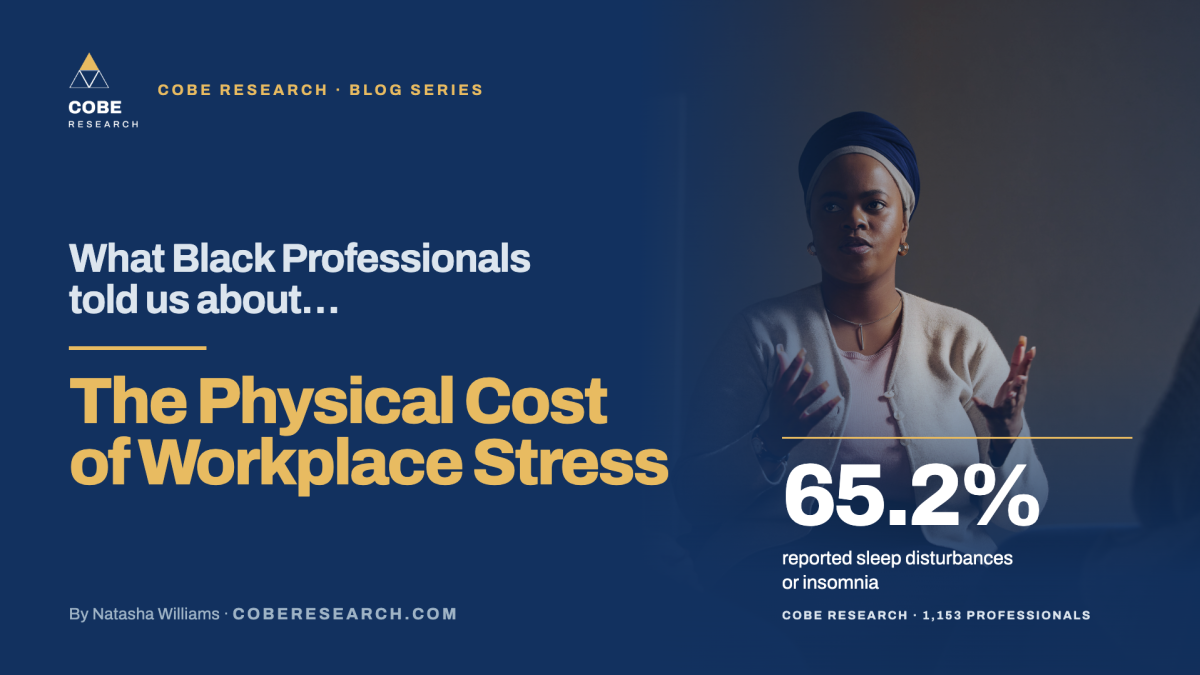
COBE Research explores fatigue, sleep disruption, vigilance, racialised stress and the physical cost of work for Black professionals.
For many Black professionals, workplace stress is discussed as though it begins and ends with the working day.
A difficult meeting happens. A comment is made. Your competence is questioned. You decide whether to respond. You adjust your tone. You prepare more than usual because you do not want to leave room for doubt.
You get through the day.
Then you go home.
But what happens when your body does not leave the experience at work?
What happens when the pressure begins to show up in your sleep, your energy, your muscles, your digestion, your ability to relax and your capacity for life outside work?
This is one of the questions emerging from COBE Research.
More than 1,100 Black, mixed Black heritage and other Global Majority professionals have contributed to our research into workplace pressure, progression, identity and wellbeing. The latest dataset contains 1,153 responses.
When we asked participants whether their physical or emotional health had been affected by their work environment or career experiences:
These findings do not establish that racialised workplace stress caused every health condition reported by participants. People's health is shaped by many factors.
But they raise an important question.
What happens to a Black professional after years of continually adapting to workplace environments that require more than simply doing the job?
One participant described the experience in language that captures this distinction:
“By the end of the day, I’m not tired from the work, which I love, but from the constant vigilance. It feels as though I’m always on alert, as if danger or judgement is waiting around me.”
The work was not necessarily the only source of exhaustion.
The environment surrounding the work was consuming energy too.
Black professionals told us the pressure accumulates
A single uncomfortable workplace experience rarely explains someone's health.
One meeting is unlikely to explain years of fatigue. One microaggression does not explain someone's blood pressure. One period of overwork does not necessarily explain persistent sleep disruption.
The concern is accumulation.
For some Black professionals, workplace pressure happens repeatedly across years and sometimes decades.
Racialised workplace pressure is distinct from ordinary workload because questions of identity, credibility, belonging and safety sit alongside the work itself.
One COBE Research participant described the accumulation this way:
“It shows up as the extra hours, energy, and emotional labour it takes to prove I belong. It’s the code-switching, the self-editing, and the constant pressure to outperform, all while carrying the weight of representation. It costs authenticity, peace, and sometimes health.”
Another participant said:
“It is exhausting to have to continually assess how you speak, how you present yourself, and whether expressing yourself authentically will be interpreted as confidence or instead as being ‘aggressive’, ‘brash’, or ‘difficult’. That level of code-switching and self-monitoring takes a significant toll.”
These accounts shift the discussion away from whether Black professionals are resilient enough.
Many have already demonstrated enormous resilience.
A more useful question is:
What is continually having to be resilient doing to the person?
The weathering effect offers one way of understanding cumulative pressure
Public health researcher Professor Arline Geronimus introduced the weathering hypothesis in the early 1990s.
Her work proposed that repeated exposure to social, economic and racial disadvantage could contribute to earlier deterioration in health among Black Americans.
Weathering does not suggest that being Black causes poorer health.
The theory focuses on repeated exposure to unequal social conditions and the physiological burden associated with responding to them over time: the cumulative impact of chronic exposure to racial stress on the body.
One related concept is allostatic load.
Allostasis describes the way the body adjusts to challenges and helps us respond to threat. When a stressful situation occurs, several systems become active.
This response is useful.
The difficulty arises when stress systems are activated repeatedly without sufficient opportunity for recovery.
Allostatic load refers to the cumulative physiological burden associated with this repeated adaptation. Researchers study allostatic load through combinations of cardiovascular, metabolic, immune and neuroendocrine indicators.
A 2025 systematic review examined perceived discrimination and allostatic load in Black populations. Another systematic review and meta-analysis published for 2026 found that four of five included studies identified significant associations between some forms of discrimination and higher allostatic load, although the pooled result was not statistically significant and the studies varied substantially in their methods.
That uncertainty matters.
We should not turn weathering into a simple equation where discrimination automatically produces a particular disease. Human health is more complex.
What current research does support is the importance of studying how sustained psychosocial stress and discrimination become connected with health over time.
A systematic review of 41 studies examining the weathering hypothesis found that most studies provided some support for weathering, while the strength of evidence differed between populations and health outcomes.
The emerging question for workplace research is therefore significant:
If a Black professional experiences racialised stress repeatedly across a 20-, 30- or 40-year career, what is the cumulative cost?
Vigilance creates work before anything has happened
One of the clearest themes emerging from our research is vigilance.
Vigilance is the state of anticipating what might happen and adjusting your behaviour accordingly.
None of these activities necessarily appears on a workload report.
They still require energy.
A participant told us:
“There’s this constant pressure to prove yourself over and over again, to be ‘exceptional’ just to be considered ‘enough,’ while watching others receive recognition for doing far less. I wish people understood the emotional exhaustion that comes from code-switching, from self-policing, from always being ‘on.’”
Another described the expectations like this:
“There’s been this constant, unspoken expectation that I have to operate at 150% just to be seen… That kind of imbalance has been exhausting and demoralizing. It’s made me feel like I can never let my guard down, never show vulnerability, and never simply be.”
This is important when thinking about health.
The stress does not only exist when something overtly discriminatory happens.
Anticipating the possibility of judgement can itself become part of the experience.
The body might therefore be responding to a workplace environment long before an organisation records an incident, complaint or absence.
Seniority does not necessarily remove the pressure
We often assume career progression brings greater autonomy.
In some ways, it does. Seniority might bring more control over schedules, higher income, decision-making authority and greater professional influence.
But several Black professionals in the COBE research described another side of progression.
Greater seniority sometimes brought increased visibility. They became one of fewer Black people in the room. Their decisions became more visible. They represented teams or organisations externally. Expectations increased. The burden of representation increased.
The professional might have more formal power while still feeling racially isolated.
Progression might bring greater control while also producing increased visibility, scrutiny and isolation for some Black professionals.
This matters when discussing the physical cost of workplace pressure.
Black professionals do not necessarily reach a level of seniority where racialised stress disappears.
The form of the stress might change.
High performance might hide declining wellbeing
One of the most dangerous assumptions organisations make is that someone who is performing well must also be doing well.
The COBE findings challenge this.
A Black professional might continue producing excellent work while sleeping badly.
They might meet every deadline while taking painkillers for tension headaches.
They might manage a team while experiencing panic.
They might receive another promotion while becoming emotionally depleted.
They might be described as dependable while spending each weekend recovering enough to return on Monday.
One executive told us:
“It shows up as burnout. Not being able to balance work and home. Ignoring family and friends. Painkillers for tension and pain. Joint pain.”
Another said:
“It’s just exhausting. Period. I’m just always tired, and it’s as if my work never stops. My brain is always worried about this work thing or that work thing.”
This is why high functioning should not automatically be interpreted as healthy functioning.
The organisation sees performance.
The professional experiences the cost of producing it.
Current research is finding similar patterns
COBE's findings sit alongside a growing body of research examining the health implications of anti-Black racism in professional workplaces.
A 2025 qualitative study of 24 Black professionals working across sectors in Canada examined workplace anti-Black racism and health.
Researchers identified microaggressions, overt bias and tokenism alongside mental health trauma, career stagnation and worsening of some chronic health conditions. Participants also described code-switching, self-preservation and leaving workplaces early.
Importantly, the study found that academic achievement and seniority did not necessarily protect Black professionals from discrimination.
That finding matters for the COBE research because our participants are also highly qualified professionals.
Many have done precisely what conventional career advice tells them to do. They gained qualifications. They built experience. They progressed. They performed. They learned how organisations work.
Yet professional achievement did not automatically remove racialised workplace pressure.
This suggests that we need to be careful about positioning individual success as the solution to structural workplace conditions.
A Black professional cannot qualification their way out of every discriminatory experience.
They cannot perform their way out of every stereotype.
They cannot regulate their way out of every psychologically unsafe environment.
The Performance Tax creates one pathway to exhaustion
COBE describes one part of this experience as the Performance Tax.
The Performance Tax refers to the additional effort some Black professionals feel required to invest in demonstrating competence and maintaining credibility.
In practice, this might mean preparing longer. Checking work repeatedly. Taking fewer risks. Avoiding mistakes. Remaining constantly available. Taking on additional responsibility. Working beyond the requirements of the role.
The behaviour might look like ambition from the outside.
But motivation matters. There is a difference between:
Over time, this distinction matters.
The Survival Tax captures what performance begins to cost
COBE uses the Survival Tax to describe another part of the experience.
The Survival Tax focuses on the personal resources consumed by continually managing workplace pressure.
The professional might still be successful. They might even be becoming more successful.
The question changes from “Are they coping?” to “What is coping costing them?”
That question becomes especially important when someone spends increasingly large parts of their non-working life recovering from their working life.
Your body does not make the career decision for you.
But your health belongs in the evidence you use to make the decision.
Leaving the job does not always mean the body immediately recovers
Black professionals sometimes make the decision to leave.
Leaving might remove someone from the environment generating the pressure.
But recovery might take longer.
Sleep patterns do not necessarily reset immediately. Confidence might require rebuilding.
A person who has spent years being vigilant might enter a healthier workplace and still initially expect danger.
Someone who has learnt to over-prepare might continue doing so long after the original reason has disappeared.
A professional might leave the organisation while carrying the behaviours the organisation helped create.
Removing the source of pressure does not necessarily reverse years of accumulated strain immediately.
One participant in COBE Research described reaching the point where leaving had become part of protecting their wellbeing:
“I’m emotionally and mentally exhausted, now on long-term sick leave with no intention to return… using this time to recover and plan my exit.”
This helps explain why career decisions and health decisions should not be treated as separate conversations.
What should Black professionals do with this information?
Understanding the possibility of cumulative workplace stress should not lead to fear.
Nor should every headache, poor night's sleep or difficult week be attributed to racism or work.
The value lies in recognising patterns.
Start with your health data
Pay attention to changes in your body over time.
If symptoms concern you, speak to an appropriate healthcare professional. Explain the wider context. Tell them how long symptoms have been present. Explain what is happening at work.
Your work environment is relevant health information.
Separate workload from racialised workload
Ask yourself:
What is exhausting me?
Is the job simply too demanding? Or are you also carrying continual proving, microaggressions, isolation, scrutiny, code-switching or fear of mistakes?
You cannot make a clear decision about a problem until you identify the problem accurately.
Audit your proving behaviours
Look closely at what you do to remain credible.
- How much more are you preparing than the work requires?
- Where are you struggling to say no?
- Are you accepting responsibilities outside your role?
- Are you repeatedly checking work that is already strong?
- Are you making yourself permanently available?
Ask which behaviours still protect you and which have become expensive habits.
Create recovery before crisis
Recovery should not begin only after collapse.
- Protect sleep.
- Protect time away from work.
- Protect relationships.
- Seek appropriate clinical or psychological support when needed.
- Use occupational health where suitable.
- Build professional support outside your immediate reporting line.
The goal is not to become better at tolerating harmful conditions.
The goal is to restore enough capacity to think clearly about what needs to happen next.
Put health into your career calculations
Career decisions often focus on salary, title and opportunity.
Add another question:
What is this environment costing me?
Then consider the four routes we use at COBE:
Your health should sit inside the decision rather than becoming the price of the decision.
Organisations need to examine what their wellbeing data might be hiding
This research also presents a challenge to employers.
Most organisations already collect some information about health: sickness absence, occupational health referrals, employee assistance programme usage, engagement surveys, turnover and stress-related absence.
But workforce averages can conceal significant differences between groups.
Where lawful and ethically appropriate, organisations should examine whether Black and other Global Majority employees report different experiences of stress, psychological safety, progression, absence and exit.
A difference does not prove discrimination.
It does create a reason to investigate.
Wellbeing becomes more useful when organisations examine the conditions creating the pressure rather than concentrating solely on helping individuals tolerate it.
Counselling, coaching and flexible working all have value, but individual support alone does not correct unfair progression processes, racialised scrutiny, repeated microaggressions or psychologically unsafe cultures.
The organisation cannot outsource the solution to resilience
Resilience has value. Black professionals demonstrate it every day.
But resilience should not become a mechanism through which organisations avoid examining their own systems.
A meditation app cannot change biased decision-making.
A wellbeing webinar cannot repair an unfair promotion process.
An employee assistance programme cannot make an unsafe manager safe.
A mental health day cannot resolve repeated microaggressions.
Individual support and organisational change need to operate together.
One protects the individual. The other addresses the conditions generating the pressure.
Your body belongs in the conversation about success
Black professionals receive constant advice about achievement.
Gain another qualification. Become more visible. Network. Build confidence. Find a mentor. Get a sponsor. Take the opportunity. Work harder. Become more resilient.
Some of this advice helps.
None of it should require someone to ignore what their career is doing to their health.
A career should create opportunity. It should strengthen financial security. It should create professional growth. It should give someone greater choice.
And success should leave enough of the person available for the rest of their life.
The physical cost of workplace stress deserves greater attention because workplace experiences do not remain neatly contained inside meetings, performance reviews and promotion decisions.
They travel home. They affect sleep. They consume energy. They influence relationships. They shape the decisions people make about whether to stay.
For Black professionals, the weathering literature offers one framework for understanding why years of racialised stress deserve attention.
Our research adds the voices of professionals describing what that cumulative pressure feels like from inside a career.
The message emerging from those voices is clear.
Do not wait until your performance collapses before asking what your performance is costing you.
Your body is part of your career data.
Pay attention to it.
Continue on the pathway
References and further reading
Geronimus, A. T. introduced the weathering hypothesis to explain how cumulative exposure to social disadvantage might contribute to earlier deterioration in health among Black populations. Subsequent systematic review evidence has generally supported aspects of the hypothesis, although findings vary across health outcomes and populations.
Harb, A. and colleagues (2025/2026). Recent systematic reviews have examined discrimination and allostatic load among Black populations. Studies frequently report relationships between discrimination and multisystem physiological stress, although pooled estimates and methodologies remain inconsistent.
Mugambi, D. A., Keshavjee, K., Aygun, O. E., Mbinda, T. K. & Guergachi, A. (2025). Workplace inequities and health outcomes among Black professionals in Canada. PLOS ONE. Researchers found experiences of anti-Black racism were connected with mental health trauma, career stagnation, chronic health concerns, code-switching, self-preservation and workplace exit.
Continue exploring What Black Professionals Told Us About…
Categories: : What black professionals told us about ...