What Black Professionals Told us About Speaking Up at Work
 Natasha Williams
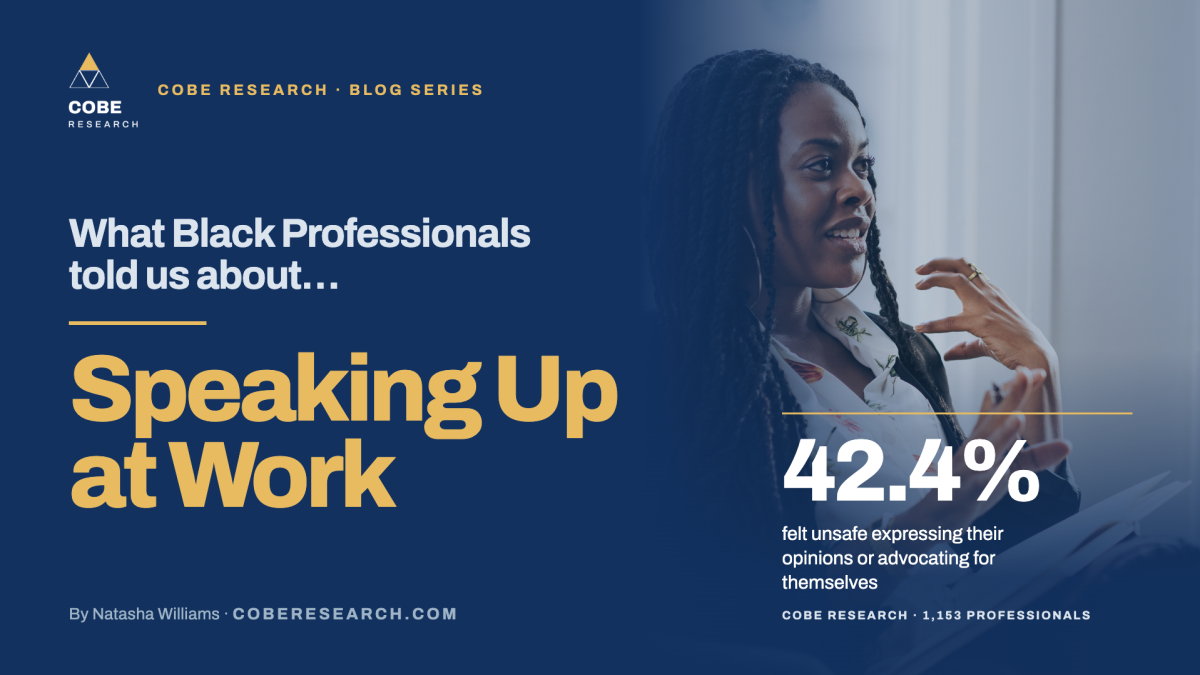
What happens when Black professionals experience bias, microaggressions or unfair treatment at work but do not feel safe speaking up?
Something happens at work and immediately makes you uncomfortable. A colleague makes a racially coded remark during a meeting, a manager begins speaking to you differently from your peers, or an opportunity disappears without a clear explanation. In other situations, feedback changes after you challenge a decision, or you find yourself excluded from conversations in which your role would normally require your participation.
The incident itself is only one part of the experience.
For many Black professionals, what follows is a period of assessment. They begin weighing what happened, what it might mean, whether it should be challenged and what the consequences of raising it might be.
The questions often arrive quickly.
These decisions matter because speaking up does not take place in a vacuum. The professional is considering what happened while also assessing their position within the organisation.
COBE Research provides important context for understanding this process.
Taken together, these findings suggest an important tension.
Black professionals might experience behaviour they believe warrants challenge while simultaneously working in environments where challenging that behaviour feels professionally risky.
This research briefing examines what Black professionals told us about speaking up, remaining silent and documenting workplace experiences. It also considers what these findings mean for psychological safety, wellbeing, career decisions, and organisational practice.
Psychological safety shapes whether people speak up.
Psychological safety is often discussed as the freedom to contribute ideas, ask questions, disagree with colleagues, and admit mistakes without fear of humiliation or punishment.
The concept has become widely recognised in organisational psychology because employees need a reasonable level of interpersonal safety to participate fully at work.
For Black professionals, psychological safety also has another dimension.
The question is not simply whether someone feels comfortable contributing an idea. It also concerns whether they believe it is safe to name behaviour they experience as unfair, biased or discriminatory.
A workplace might encourage innovation and debate while remaining less comfortable discussing race.
An employee might feel confident questioning a project plan while feeling far less confident challenging a racially coded remark from a senior colleague.
Those are different forms of voice.
The COBE findings suggest that many Black professionals are making careful calculations about when and how they use theirs.
The decision to speak up carries professional considerations
Workplace guidance often presents reporting concerns as a fairly linear process. An employee experiences a problem, raises the issue with a manager or Human Resources, and the organisation responds.
Real experiences are often more complex.
A Black professional might consider how the concern will affect an established relationship with their manager. Someone else might worry about being labelled difficult, sensitive or confrontational. Another person might question whether raising race will cause colleagues to become defensive.
Stereotypes also matter.
Research on racialised workplace experiences has repeatedly documented how Black employees sometimes manage perceptions of assertiveness, anger and professionalism. These pressures mean that the person raising a concern might also be monitoring the tone, language and emotional expression they use while doing so.
The employee is therefore carrying two tasks at once.
That additional calculation is easy to overlook.
Silence should not automatically be interpreted as acceptance
Organisations sometimes interpret a lack of complaints as evidence that employees are broadly satisfied.
The COBE findings suggest greater caution is needed.
Silence can mean many things.
An employee might not believe the incident was serious enough to report. Another person might prefer to resolve the matter informally. Someone else might lack confidence in the internal process.
For some Black professionals, silence might also represent self-protection.
A person might decide that speaking up creates more professional risk than remaining quiet. They might believe the manager involved has enough organisational influence to make challenging the situation unsafe. Previous experiences could also shape expectations about whether the concern will result in meaningful action.
Remaining silent does not therefore tell us how the employee experienced the event.
Nor does it mean the event had no effect.
An individual might continue performing while privately reconsidering their relationship with the organisation.
What remains unspoken still requires processing
The workplace interaction may end within minutes, yet its effects often continue.
A professional might replay a conversation later that evening. They may question whether they interpreted the behaviour correctly, consider what they should have said or worry about what will happen next.
Future interactions might also change.
Someone who previously contributed freely during meetings may begin speaking less. Another employee might become more cautious around a particular manager. A person who felt overlooked for an opportunity could reduce discretionary effort or start exploring roles elsewhere.
These responses matter because the organisational consequences of workplace experiences do not always appear immediately.
An employee can remain productive while becoming psychologically detached from the organisation.
They can continue meeting deadlines while losing trust.
Someone can still attend meetings while no longer feeling safe enough to contribute honestly.
By the time a resignation appears in organisational data, the process leading to that decision might already have been developing for months.
Documentation gives Black professionals another form of choice
One of the most practical themes arising from this discussion is the value of documentation.
Keeping a factual record does not automatically mean someone intends to make a formal complaint. Nor does it require the professional to conclude immediately that discrimination has occurred.
Documentation serves a different purpose.
It preserves information.
A written account allows someone to record what happened while the details remain clear. Dates, language, witnesses and the sequence of events become harder to reconstruct as time passes.
More importantly, individual incidents often become easier to interpret when viewed over time.
One exclusion from a meeting might be accidental. Repeated exclusion from meetings relevant to someone's responsibilities raises a different question.
A single piece of critical feedback may be legitimate. A sudden change in performance feedback immediately after an employee raises a concern might warrant closer attention.
One uncomfortable comment can be difficult to interpret. A pattern of comments involving similar assumptions provides more context.
Documentation therefore helps the professional move from a general feeling that something is wrong towards a clearer understanding of what has been happening.
Self-doubt often sits alongside workplace ambiguity
Subtle workplace behaviour often creates uncertainty.
Black professionals might question whether race was relevant to what happened. They may wonder whether they are being overly sensitive or whether there is another explanation.
Such reflection is reasonable.
Not every disagreement is discrimination. Not every difficult manager is motivated by racial bias. Differences in treatment require context.
Yet continual self-doubt can create its own burden.
When a person repeatedly talks themselves out of their own observations, they lose access to information that might be important.
A contemporaneous record provides a more stable point of reference.
Instead of relying on memory several months later, the professional can return to what they recorded at the time.
They can consider whether similar incidents continued, whether the organisation responded consistently and whether their own experience changed.
The record does not determine the explanation.
It improves the evidence available for making sense of it.
Useful documentation is factual rather than dramatic
The purpose of documentation is accuracy.
Each record should give enough context for another person to understand what happened.
For example, someone may have believed that challenging a senior leader during a public meeting would expose them to unnecessary professional risk.
That decision tells us something about psychological safety.
None of these reactions needs to be exaggerated.
A straightforward description of what changed is more useful than emotionally heightened language.
Patterns are often more informative than isolated incidents
Racialised workplace experiences frequently become clearer when viewed across time.
This is particularly relevant to microaggressions.
A single incident might appear minor in isolation. Repetition changes the picture.
The professional might notice that the same colleague consistently questions their expertise. Someone else might identify a pattern where their ideas gain support only after another colleague repeats them.
Another employee might observe that feedback becomes disproportionately critical when they disagree with a manager.
Patterns can also emerge around opportunity.
Comparisons do not prove discrimination on their own.
They do provide useful information.
A pattern of differential treatment deserves more attention than a single unexplained event.
Written evidence often already exists
Workplace experiences do not always rely solely on personal notes.
Many organisations already create extensive written records through email, messaging platforms, meeting invitations, performance systems and formal correspondence.
The important issue is knowing what evidence exists and where it is located.
Written follow-up strengthens clarity
Significant workplace conversations often happen verbally.
A concern is raised during a meeting. A manager agrees to take an action. A conversation with Human Resources ends with a promise to review the matter.
Later, memories differ.
Following an important verbal discussion with a short factual email creates clarity.
A message might explain that the employee is confirming their understanding of the discussion, briefly state the issue raised and record any next steps agreed.
The purpose is not to create confrontation.
It is to reduce ambiguity.
Written follow-up also records that the organisation was made aware of the concern.
Where promised action does not follow, the response becomes part of the wider record.
Speaking up sits within a broader health and wellbeing context
The decision to challenge workplace behaviour cannot be separated entirely from wellbeing.
Repeated experiences of bias, scrutiny and uncertainty require psychological effort.
COBE Research has found substantial levels of fatigue, sleep disruption, burnout and emotional strain across the participant population.
For some Black professionals, speaking up becomes one element of a wider pattern of racialised workplace stress.
When this happens repeatedly, the burden extends beyond the original interaction.
This is one reason organisations should avoid treating individual complaints as completely isolated events.
The cumulative context matters.
Human Resources has an important but specific role
Black professionals sometimes approach Human Resources expecting the department to act as an independent advocate.
The reality is more nuanced.
HR operates within the organisation. Its responsibilities include supporting employment processes, advising management, managing organisational risk and helping to maintain fair workplace practices.
That does not mean employees should avoid HR.
It does mean preparation matters.
A professional entering an important conversation is in a stronger position when they have dates, examples and a clear chronology.
They should also think about the outcome they are seeking.
Clear evidence and a clear objective make the conversation easier to understand.
Where the stakes are high, or where someone lacks confidence in the internal process, independent advice might also be appropriate.
Speaking up and formal legal action are different decisions
In Great Britain, race is protected under the Equality Act 2010. The legislation covers colour, nationality, ethnic origins and national origins.
Race discrimination in employment can take different forms, including direct discrimination, indirect discrimination, harassment and victimisation.
A Black professional does not need to decide immediately which legal category applies when an incident occurs.
The initial task is simpler.
Record what happened accurately.
Legal interpretation can come later if it becomes necessary.
This distinction is important because difficult workplace experiences already create enough cognitive and emotional pressure. The employee should not also feel responsible for conducting a legal analysis while trying to process what happened.
Where formal legal action becomes a consideration, advice from an appropriately qualified employment professional is important.
Evidence also informs career decisions
Documentation is often associated with grievances, investigations and legal disputes.
Its value extends beyond formal processes.
Evidence also helps someone assess whether remaining within an organisation still makes sense.
A record may show that one relationship is responsible for most of the difficulty. In that situation, moving to another team or reporting line might materially change the experience.
Another professional might find that the organisation responds positively when concerns are raised. Challenging the issue while remaining in the role might therefore be appropriate.
A different record might show repeated incidents across several leaders, weak organisational responses and worsening health.
That pattern creates a different decision.
COBE uses four broad options when examining workplace choices. Each option requires information.
Documentation helps the professional make these decisions with greater clarity.
What organisations should learn from employee silence
The findings also raise important questions for employers.
An organisation with few formal complaints should not assume that employees feel safe.
Low reporting might reflect a healthy culture.
It might equally reflect low confidence in what happens after someone speaks.
Organisations therefore need to assess psychological safety more broadly.
Employee surveys provide one source of information. Exit interviews provide another. Patterns in turnover, progression, employee relations cases, occupational health referrals, and internal mobility also deserve examination.
Qualitative information matters because aggregate data rarely explains why employees behave as they do.
Leaders should ask whether employees trust internal processes. They should consider whether different demographic groups report different experiences of speaking up. Managers need to know whether employees believe disagreement is tolerated.
Organisations should also examine what happens to people after concerns are raised.
Silence creates organisational risk
When employees do not feel able to raise concerns, organisations lose information.
Problems remain hidden. Managers miss opportunities to intervene early. Leadership teams receive an incomplete picture of workplace culture.
Employees might continue performing while privately disengaging.
Some will eventually leave.
Others might remain but contribute less openly because speaking honestly feels unsafe.
The organisational cost therefore extends beyond formal complaints.
Psychological safety influences learning, communication, decision-making, wellbeing and retention.
When Black professionals calculate that silence is safer than honesty, both the individual and the organisation lose something.
The Black professional remains at the centre of the decision
There is no single correct response to every difficult workplace experience.
Some situations require an immediate challenge. Others benefit from observation and documentation. Certain problems can be resolved informally. Some require formal processes or independent advice. In other circumstances, leaving the environment becomes the healthiest decision.
What matters is preserving agency.
Black professionals should have enough information to assess what is happening without being forced into an immediate choice between silence and escalation.
Documentation supports that agency.
It creates space between the event and the response.
A professional can record what happened, observe what follows and decide what action serves their wellbeing and career.
That is particularly important where racialised workplace experiences are subtle, repeated or difficult to explain in isolation.
What Black professionals told us is ultimately about safety and choice
The data tells us that workplace bias and microaggressions are common within this participant group.
It also tells us that many Black professionals do not feel fully safe expressing opinions or advocating for themselves.
Those findings help us understand why speaking up requires more than courage.
A formal policy might explain how someone should raise a concern, but policy alone does not determine whether the person believes using that process is safe.
Black professionals in the research have shown us why this distinction matters.
They are often making sophisticated assessments about risk while continuing to perform their roles.
Their silence should not automatically be interpreted as acceptance. Their documentation should not automatically be interpreted as preparation for conflict. In many cases, both are attempts to protect choice.
The wider lesson is straightforward.
Employees need workplaces where they can raise concerns without fearing that doing so will create a second problem.
Until that becomes more consistent, Black professionals also need practical ways to preserve their own evidence, monitor patterns and make decisions with greater clarity.
The aim is not to turn every difficult interaction into a formal case.
The aim is to ensure that the professional does not lose sight of what has happened while deciding what should happen next.
When Black professionals feel able to speak without sacrificing credibility, wellbeing or career opportunity, both the professional and the organisation are better positioned to respond before problems escalate.
Continue on the pathway
Continue reading: What Black Professionals Told Us About…
Categories: : What black professionals told us about ...