What Black Professionals told us about Burnout
 Natasha Williams
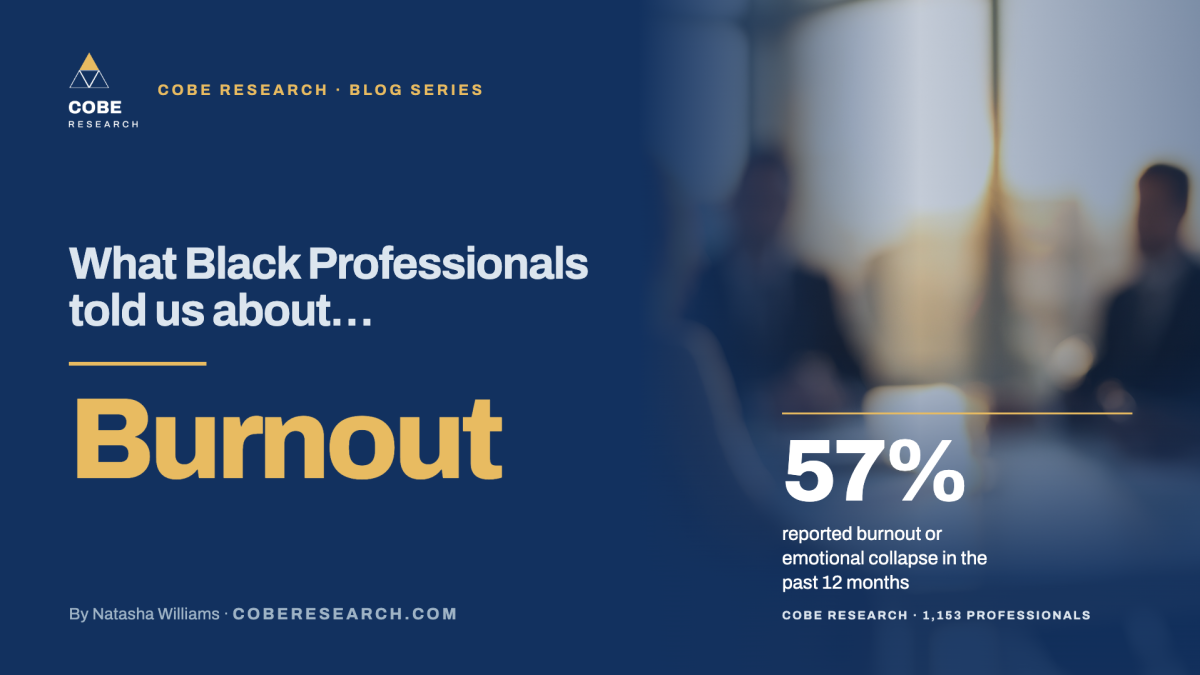
For Black professionals who contributed to COBE Research, burnout developed while they were working and experiencing racialised stress daily.
Burnout does not begin when a Black professional stops performing
For many of the Black professionals who contributed to COBE Research, burnout did not begin with an absence from work, a resignation, or a dramatic collapse.
It developed while they were still working.
They delivered projects, met deadlines, supported colleagues, and progressed in their careers while appearing capable.
What changed was the amount of physical, psychological, and emotional energy required to sustain that performance.
In the latest COBE Research dataset, 1,153 professionals shared their experiences of work, progression, identity, health, and wellbeing. The sample is predominantly Black, including Black African, Black Caribbean, Black British, Black Americans, and mixed Black heritage professionals, alongside a smaller number of other Global Majority respondents.
The health findings require attention.
When participants were asked more broadly whether their physical or emotional health had been affected by their work environment or career experiences:
These figures do not tell us that every symptom was caused exclusively by work, racism or discrimination. The survey was not designed to establish clinical causation.
They do tell us something important.
A substantial proportion of the Black and Global Majority professionals who participated in this research are working while carrying significant levels of physical and emotional strain.
One Director described the experience this way:
“By the end of the day, I’m not tired from the work, which I love, but from the constant vigilance. It feels as though I’m always on alert, as if danger or judgement is waiting around me.”
This sits at the centre of the findings.
For some Black professionals, exhaustion came from everything they felt they had to do at work to remain safe, credible, accepted, and successful.
What do we mean by burnout?
The World Health Organisation defines burnout as an occupational phenomenon resulting from chronic workplace stress that has not been successfully managed. The WHO identifies three dimensions: energy depletion or exhaustion, increased mental distance from work or cynicism, and reduced professional efficacy. Burnout is classified as an occupational phenomenon rather than a medical condition.
This definition is useful, but the experiences captured through COBE Research suggest that we also need to examine what generates the chronic workplace stress in the first place.
Workload is an important factor, and some people work long hours. As in other groups, long hours, a lack of autonomy, poor management, job insecurity, and a mismatch between effort and reward also contribute. But for Black professionals, these were minimum demands, and what was required extended far beyond these established occupational stressors.
Participants described having to monitor their behaviour, anticipate stereotypes, prove their competence repeatedly, regulate their emotional responses, determine whether challenging behaviour would damage their careers, change how they spoke, manage other people's assumptions and calculate how much of themselves they felt safe to reveal.
One senior Black professional described the cost succinctly:
“It shows up as the extra hours, energy, and emotional labour it takes to prove I belong. It’s the code-switching, the self-editing, and the constant pressure to outperform, all while carrying the weight of representation. It costs authenticity, peace, and sometimes health.”
That helps explain why a general conversation about burnout is insufficient.
Black professionals experience the same organisational demands as other employees. Some also carry racialised demands that are less visible within conventional workload measures.
The additional demand of having to prove competence
The COBE findings show how widespread competence-proving pressure is within the sample.
Only 3.6% selected rarely or never.
This matters because effort is not an unlimited resource.
The Job Demands–Resources model, developed through decades of occupational psychology research, proposes that sustained job demands consume physical and psychological resources, particularly when employees do not have sufficient resources to meet those demands. High demands without adequate resources increase the likelihood of exhaustion and burnout. More recent reviews continue to support the central role of job demands and resources in employee wellbeing.
For the Black professional, the question becomes:
What counts as a job demand?
A workload dashboard might record 40 hours of work.
It rarely documents the extra effort someone makes because they fear harsher judgment for errors.
The system does not evaluate the time spent reviewing a meeting to judge if an assertive comment was seen as aggression.
It fails to account for the effort involved in deciding to challenge a microaggression.
It does not illustrate the mental exertion involved in continuously transitioning between different language, expression, or behaviour forms.
It rarely evaluates the tension that comes from the idea that one person's actions might symbolise the entire group.
One Principal Consultant summed up this experience perfectly:
“There’s this constant pressure to prove yourself over and over again, to be ‘exceptional’ just to be considered ‘enough,’ while watching others receive recognition for doing far less. I wish people understood the emotional exhaustion that comes from code-switching, from self-policing, from always being ‘on.’”
The participant went further:
“There’s been this constant, unspoken expectation that I have to operate at 150% just to be seen… That kind of imbalance has been exhausting and demoralising. It’s made me feel like I can never let my guard down, never show vulnerability, and never simply be.”
This is more than a confidence issue.
It is a resource issue.
A professional who feels unable to have an average day is operating under a different psychological demand from a colleague who assumes that one mistake will remain one mistake.
Burnout, effort, and unequal reward
Another established occupational health model helps explain the findings.
Johannes Siegrist's Effort–Reward Imbalance model proposes that work becomes particularly stressful when high effort is not matched by sufficient reward. Reward includes salary, esteem, security, recognition and career opportunities. The model has accumulated a substantial evidence base over the past three decades linking sustained effort–reward imbalance with poorer health outcomes.
This becomes significant when Black professionals describe working harder while also experiencing barriers to recognition, sponsorship, progression and psychological safety.
High effort combined with lower perceived reward creates a different psychological equation from high effort followed by recognition, advancement and increased control.
The issue is not effort alone.
The issue is what the professional receives in return for sustained effort.
One reason burnout and career advancement must not be considered separate topics within an organisation is this:
- Progression is part of wellbeing.
- Recognition is part of wellbeing.
- Fairness is part of wellbeing.
- Being taken seriously is part of wellbeing.
A senior manager in the COBE study described what happened when the pressure to prove competence became connected to physical and psychological health:
“The excellence tax shows up for me as severe mental and physical burnout and stress… It’s been taxing to have to code switch to professionally survive.”
The language of survival appears repeatedly across Black workplace research. It suggests professional functioning in which performance becomes protective.
The employee works harder because working harder feels safer.
The employee prepares more because being unprepared feels riskier.
The employee stays composed because showing frustration feels professionally dangerous.
These strategies might produce excellent performance.
They might also produce exhaustion.
The health impact extends beyond feeling tired
Burnout is often discussed casually as extreme tiredness.
The COBE data point towards a wider health picture.
Almost two-thirds of participants reported sleep disturbance.
Nearly two-thirds reported persistent fatigue.
More than four in ten reported anxiety or panic attacks.
Muscular tension, headaches, digestive problems and emotional numbness also appeared frequently.
One Black executive described burnout in explicitly physical terms:
“It shows up as burnout. Not being able to balance work and home. Ignoring family and friends. Painkillers for tension and pain. Joint pain.”
Another mixed Black heritage executive wrote:
“It’s just exhausting. Period.”
They continued:
“I’m just always tired, and it’s as if my work never stops. My brain is always worried about this work thing or that work thing.”
These experiences fit within a much wider body of research on discrimination and health.
A major meta-analysis by Pascoe and Smart Richman, drawing on 134 samples, found perceived discrimination was associated with poorer mental and physical health, heightened stress responses and health-related behavioural changes.
More recent research has begun examining these relationships specifically among Black professionals.
A 2025 peer-reviewed study of Black professionals in Canada found workplace anti-Black racism was associated with mental health trauma, career stagnation and worsening of some chronic health conditions. Participants described microaggressions, tokenism, code-switching, self-preservation and early workplace exit. The researchers noted that high academic achievement and seniority did not remove exposure to discrimination.
This finding is important.
Professional success does not necessarily protect a Black employee from racialised workplace stress.
In some cases, progression places the professional into environments where they are more isolated.
Vigilance: the work happening before anything happens
One of the clearest themes within the COBE responses is vigilance.
Vigilance refers to anticipating discrimination and changing or monitoring behaviour in preparation for it.
This is important because harm does not require a discriminatory event to occur every hour of every day.
Anticipating what might happen also requires psychological effort.
Earlier research with Black adults found vigilant coping helped explain the relationship between discrimination and stress, with stress then associated with depressive symptoms.
New research published in 2026 adds an important physiological dimension. A study using ecological momentary assessments and heart monitoring found Black participants reported more frequent vigilance than White participants. Episodes of vigilance were associated with poorer emotional wellbeing and changes in cardiovascular functioning. The researchers describe vigilance as one mechanism through which racism might “get under the skin”.
This gives context to the COBE participant who told us:
“It feels as though I’m always on alert, as if danger or judgement is waiting around me.”
Their experience should not be reduced to oversensitivity.
Vigilance is a recognised stress process.
Code-switching and identity management consume energy
Another major finding deserves equal attention.
Examples within the survey included voice, hair, emotions and cultural expression.
Identity management might help someone navigate a workplace.
The question is what happens when adaptation becomes continuous.
One participant described success as requiring:
“constant calculations: how to be authentic yet acceptable, how to excel while carrying the weight of representation, and how to win in spaces not built for you.”
Another explained:
“It is exhausting to have to continually assess how you speak, how you present yourself, and whether expressing yourself authentically will be interpreted as confidence or instead as being ‘aggressive,’ ‘brash,’ or ‘difficult.’ That level of code-switching and self-monitoring takes a significant toll.”
These accounts place the Black professional at the centre of a question organisations often miss.
How much energy does an employee have left for the job after spending energy managing the environment?
Microaggressions should be understood cumulatively
The COBE dataset also shows that experiences of racial or gender bias were widespread.
A microaggression is sometimes dismissed because a single incident might appear minor when viewed outside its wider context.
Cumulative exposure tells a different story.
Research involving 345 Black employees found workplace microaggressions were associated with burnout and lower job satisfaction. The researchers identified additional resource expenditure after microaggressions, including rumination and racism-related vigilance.
The important word here is resource.
Every calculation, recovery process, act of self-monitoring and decision about whether to respond uses psychological resources.
The effects accumulate.
The professional still has a job to do after the incident.
Burnout is also an organisational risk
These findings matter for Black professionals because health matters in its own right.
They also matter for organisations.
In Great Britain, 964,000 workers reported work-related stress, depression or anxiety in 2024/25. These conditions accounted for approximately 22.1 million lost working days.
The CIPD's 2025 Health and Wellbeing at Work research found sickness absence had risen to an average of 9.4 days per employee. Heavy workload was the leading reported cause of stress-related absence among organisations reporting stress-related absence. Although 64% of organisations were taking action to identify or reduce workplace stress, only half believed their efforts were effective.
The broader organisational wellbeing conversation is therefore already moving towards prevention.
CIPD guidance published in 2026 argues for a holistic approach which addresses psychosocial risks within work itself, rather than relying solely on support after employees become unwell.
COBE Research adds another question to that discussion:
Are organisations identifying racialised psychosocial risks with the same seriousness as workload, role clarity and management behaviour?
If they are not, their wellbeing data might only capture part of the problem.
A meditation app will not resolve repeated discrimination.
An employee assistance programme will not correct an unfair promotion process.
A resilience seminar will not eliminate heightened scrutiny.
A wellbeing day will not compensate for an employee feeling unable to speak honestly in meetings.
Individual support requires our attention.
It cannot substitute for organisational action.
Burnout often becomes visible when the employee thinks about leaving
Perhaps one of the most significant COBE findings concerns exit.
More than one in five respondents had already left a role for this reason.
This changes how organisations should interpret turnover.
A resignation occurs on a date.
The decision to resign develops over time.
Before leaving, the Black professional might have spent months trying to cope.
They might have worked harder.
- Changed their behaviour.
- Stopped challenging decisions.
- Withdrawn socially.
- Sought therapy.
- Taken sick leave.
- Applied internally.
- Waited for management to intervene.
- Lowered their expectations.
Or continued producing excellent work while quietly preparing an exit.
A 2025 observational study of racialised workplace dynamics in healthcare similarly identified heightened scrutiny, exclusion, unequal workload patterns and dismissive communication affecting Black staff, with consequences for workplace stress and attrition.
An organisation that begins asking questions at the exit interview has started too late.
What does this mean for the Black professional?
The organisational context matters, but Black professionals also need options while organisations catch up.
The answer is not greater resilience in the conventional sense.
Many participants in this research appear to have demonstrated considerable resilience already.
The more useful question is:
How do you stop using your health to subsidise your career?
Recognise what you are carrying
Begin by separating the work from the additional labour surrounding the work.
Ask yourself what consumes your energy.
- Is it the volume of work?
- The manager?
- A lack of control?
- Constant proving?
- Code-switching?
- Being overlooked?
- Isolation?
- Microaggressions?
- Fear of making mistakes?
- Lack of progression?
- Continual emotional regulation?
Burnout becomes harder to address when every form of exhaustion is labelled simply as “stress”.
Name the demand.
Take physical symptoms seriously
Persistent sleep disturbance, headaches, digestive changes, muscular tension, panic, emotional numbness and continual exhaustion deserve attention.
Do not wait for complete collapse before treating your health as relevant information.
Where symptoms persist or interfere with daily life, seek appropriate clinical support.
Your body is part of your career data.
Audit the proving
Ask:
What am I doing because the job requires it, and what am I doing because I am trying to prove that I deserve to be here?
Look at additional hours, unnecessary preparation, perfectionism, constant availability, difficulty delegating and work you accept outside your remit.
Some of those strategies might once have protected your career.
That does not mean every strategy needs to remain permanent.
Build evidence rather than continually performing evidence
- Document your achievements.
- Record outcomes.
- Keep evidence of positive feedback.
- Know the value you create.
- Track responsibilities that extend beyond your formal role.
This creates a different form of career security.
Your competence exists whether or not you exhaust yourself demonstrating it every day.
Strengthen support outside the immediate workplace hierarchy
Support might include peers, sponsors, mentors, professional networks, culturally informed therapists, coaches, occupational health practitioners and trusted senior colleagues.
This matters because of how few respondents had access to culturally sensitive support:
The quality of support matters as much as its existence.
Decide rather than endure indefinitely
COBE uses four broad options when helping professionals think through difficult workplace situations:
The purpose of the framework is to move the decision away from a binary choice between tolerating harm and resigning tomorrow.
The aim is to create options before exhaustion removes your ability to choose.
What should organisations do?
The organisational response must go further than asking Black employees to become more resilient.
- Organisations should measure psychosocial risk.
- They should examine progression and reward patterns.
- They should monitor workload and invisible labour.
- They should assess psychological safety across demographic groups rather than relying solely on workforce averages.
- They should understand who feels safe challenging decisions.
- They should examine where Black employees leave and what happens before exit.
- They should assess management behaviour.
- They should look for patterns in sickness absence, complaints, employee relations cases and internal mobility.
- They should examine whether wellbeing services are culturally credible.
- They should ask whether high performers are succeeding sustainably.
Most importantly, organisations need to stop treating performance as evidence that an employee is well.
The employee who delivers the most might also be carrying the most.
The cost behind the performance
The COBE research does not suggest that every Black professional experiences work in the same way.
Black professionals are not a homogeneous group.
Sector, gender, seniority, nationality, class, age, disability, organisational culture and individual circumstances all shape workplace experience.
What the findings do show is a pattern large enough to warrant attention.
Hundreds of professionals described exhaustion.
Hundreds described disturbed sleep.
Hundreds described burnout.
More than a thousand described feeling the need to tone down aspects of themselves.
Almost nine in ten frequently or occasionally encountered bias, microaggressions or discrimination.
More than nine in ten had contemplated leaving or had already left a role in order to protect their wellbeing.
These experiences sit at the intersection of occupational health, racialised stress, career progression and organisational risk.
They should not be treated as separate conversations.
For the Black professional, burnout might begin long before performance declines.
It might begin when excellence stops being something you pursue and becomes something you feel you must continuously demonstrate to remain safe.
It might begin when an ordinary day no longer feels available to you.
It might begin when the job takes eight hours but managing the experience of doing the job follows you home.
And this might be one of the most important findings from the research:
High performance does not tell us what performance costs.
If we want healthier careers and healthier organisations, we need to start measuring the cost.
References and further reading
World Health Organization. Burn-out an occupational phenomenon: International Classification of Diseases. The WHO defines burnout as arising from chronic workplace stress that has not been successfully managed.
Mugambi, D. A., Keshavjee, K., Aygun, O. E., Mbinda, T. K. & Guergachi, A. (2025). Workplace inequities and health outcomes among Black professionals in Canada. PLOS ONE, 20(4). This qualitative research identified microaggressions, overt bias and tokenism alongside mental health trauma, effects on chronic conditions, code-switching and workplace exit.
Hicken, M. T. et al. (2026). Vigilance and Well-Being in Daily Life: An Examination of Race Differences. Race and Social Problems. The study examined daily vigilance, emotional wellbeing and cardiovascular functioning among Black and White adults.
Bakker, A. B., Demerouti, E. & Sanz-Vergel, A. (2023). Job Demands–Resources Theory: Ten Years Later. Annual Review of Organizational Psychology and Organizational Behavior, 10, 25–53.
Siegrist, J. (2026). Effort-reward imbalance at work and health: Review and critical appraisal of three decades of research. Scandinavian Journal of Work, Environment & Health.
Pascoe, E. A. & Smart Richman, L. (2009). Perceived discrimination and health: A meta-analytic review. Psychological Bulletin, 135(4), 531–554.
Geronimus, A. T. (1992). The weathering hypothesis and the health of African-American women and infants: evidence and speculations. Ethnicity & Disease, 2(3), 207–221. The weathering framework remains influential in understanding how sustained exposure to social disadvantage might accumulate physiologically over time.
Maslach, C. & Leiter, M. P. (2016). Understanding the burnout experience: recent research and its implications for psychiatry. World Psychiatry, 15(2), 103–111.
Health and Safety Executive (2025). Health and safety statistics for Great Britain 2025. HSE reports 964,000 workers experiencing work-related stress, depression or anxiety during 2024/25.
CIPD (2025). Health and wellbeing at work 2025. The report examines sickness absence, workplace stress and organisational wellbeing practice across UK employers.
Continue exploring the research
Read more from the What Black Professionals Told Us About… series to explore how racialised workplace pressure shows up through continual proving, identity suppression, psychological safety, career progression, workplace exit and health.
For organisations, COBE Intelligence explores how these individual experiences translate into workforce risk, retention, wellbeing and organisational performance.
Categories: : What black professionals told us about ...