What Black Professionals Told Us About Continual Proving at Work
 Natasha Williams
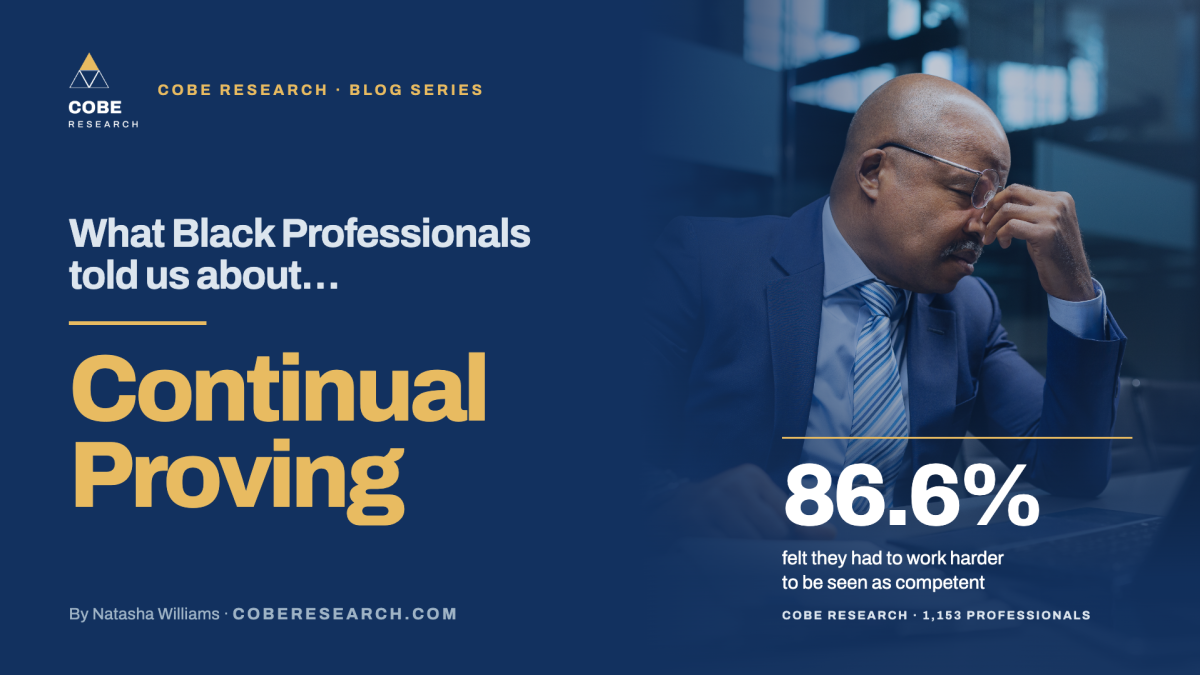
In this post, we discuss continual proving, overperformance, workplace pressure, burnout, belonging, and the costs of work.
A pattern in the Cost of Black Excellence research keeps coming back to me: the feeling that you have to continually prove you belong.
You might have the qualifications, experience, and track record required for the role, yet still find yourself working harder to establish competence, checking your work repeatedly, preparing more than everyone else or worrying about making an ordinary mistake.
The latest analysis of the COBE Research dataset found:
That figure deserves more attention because continual proving does not always look like distress from the outside. Often, it looks like performance.
Meanwhile, something else is happening underneath the performance.
As one participant told us:
“It is exhausting having to constantly feel like you have to perform.”
Another described the additional work more explicitly:
“It shows up as the extra hours, energy, and emotional labour it takes to prove I belong.”
This is where I think we need to separate two things.
Those are not the same experience.
You were qualified when they hired you
The organisation reviewed your application. Someone considered your experience. You went through the interview process. Your qualifications were available for scrutiny.
Eventually, somebody made a decision to employ you.
Yet some Black professionals describe entering the organisation and discovering that the credibility check never quite ends.
One participant put the experience plainly:
“Having to constantly show that I am credible at what I do whereas my white colleagues are taken at face value.”
That statement captures something important about continual proving.
The pressure does not necessarily come from wanting to be the best. Instead, excellence starts becoming a form of protection.
There is nothing wrong with ambition, high standards, or taking pride in your work. I have spent much of my career wanting to do my work properly and to a high standard.
The problem starts when exceptional performance feels necessary for basic professional safety.
At that point, being good is no longer enough.
These findings need to be read together rather than as isolated numbers.
Working harder to establish competence sits alongside identity management, workplace bias and reduced voice safety.
When several of those conditions are present at the same time, overperformance starts to make more sense.
Sometimes people simply do not want to listen
I remember someone telling me that once you lose someone's respect, it is incredibly difficult to regain it.
I have thought about that statement many times over the years.
These days, my response is often to pull back.
When I realise that someone has decided who they think I am, I am far less interested in spending months trying to change their mind.
There comes a point when I think, do you know what, you are simply not listening to me.
Some people genuinely do not want to listen. Sometimes someone has already created a version of you in their head, and no amount of explanation seems to move them from that position.
Continually returning with more evidence, more work, another qualification or another demonstration of competence becomes exhausting.
Eventually, your career starts to feel like a defence case.
Instead of putting your energy into your work, you find yourself arguing for your intelligence, professionalism, capability and right to be in the room.
I no longer believe every person needs to be persuaded.
Professional maturity sometimes means recognising when you need to stop investing energy in someone who has no intention of changing their view.
Pulling back does not mean behaving badly or abandoning your responsibilities. You continue to work professionally, maintain your standards and protect your reputation.
What changes is how much emotional energy you spend trying to convince someone to see something they have already decided not to see.
Comparison is another part of the story
Continual proving also creates comparison.
You begin noticing how much grace someone else receives.
Meanwhile, you are monitoring your own behaviour far more closely.
Some comparison is necessary because unequal treatment needs to be recognised and examined. Patterns in who receives opportunity, forgiveness, sponsorship and trust tell us something about workplace conditions.
Constantly looking sideways, though, takes energy.
I have experienced the other side of this as well.
There have been organisations where I knew I received more grace than some other people. A large part of that came down to my performance.
The company knew that I made them money. They understood what I delivered, what I contributed and the commercial value attached to my role.
If I was occasionally late or needed some flexibility, they were tolerant because they understood my overall contribution.
I knew what the organisation wanted from me. More importantly, I knew what I brought to the organisation.
That knowledge gave me a level of security.
There is an important difference between understanding the value you create and trying to perform yourself into the ground so that somebody will eventually consider you worthy.
Overperformance is not always ambition
We need to become more curious about why people overperform.
Sometimes the explanation is straightforward. Someone enjoys their work, has ambitious goals and wants to progress.
In other situations, performance becomes a response to fear.
A person might fear being overlooked, judged more harshly, exposed as inadequate or treated differently after making a mistake.
For some Black professionals, the internal calculation becomes: If I remain exceptional, perhaps I will remain safe.
The research voices describe the psychological cost clearly. One participant told us:
“It costs authenticity, peace, and sometimes health.”
Another explained:
“By the end of the day, I’m not tired from the work, which I love, but from the constant vigilance.”
That difference is significant.
Someone might love their profession while struggling with the conditions surrounding how they have to perform it.
The work itself is not always the source of the exhaustion.
Constant vigilance, self-monitoring, proving, identity management, and unequal scrutiny place additional demands on the work.
More than four in ten said these experiences had damaged their mental health, while almost one-third had considered quitting.
Longstanding UK evidence also shows that racialised workplace experiences are neither new nor confined to individual organisations. The McGregor-Smith Review documented widespread reports of racial harassment and bullying and highlighted persistent problems involving progression, recognition and workplace opportunity.
The issue therefore extends beyond individual confidence.
Workplace conditions shape behaviour.
The body eventually enters the conversation
Continual proving has consequences.
When someone spends months or years operating at an elevated level of vigilance and performance, the cost does not remain neatly contained within working hours.
Our research found substantial levels of sleep disturbance, persistent fatigue and burnout or emotional collapse.
This is where I think our language around high performance needs to change.
Someone continuing to produce good work does not necessarily mean they are well.
Strong output sometimes masks deteriorating recovery, poor sleep, anxiety and emotional exhaustion.
In those situations, people start using their health to subsidise their careers.
An employer gets the extra hours, extra preparation, emotional labour, and constant availability.
The individual's body absorbs the cost.
Sometimes you are simply in the wrong organisation
There is another conversation I think we avoid because we spend so much time teaching people how to fit workplaces.
Sometimes you do not fit the organisation. That does not automatically mean there is something wrong with you.
At that point, another resilience course is unlikely to resolve the underlying problem. More overperformance is unlikely to resolve it either.
The difficult part is recognising when you have moved from developing yourself to repeatedly trying to prove yourself to an environment that is giving very little back.
Sometimes people worry about moving organisations because they think their CV will look unstable. I understand that concern.
At the same time, I would rather see someone spend a period finding an environment where they can thrive than spend fifteen years slowly burning themselves out trying to make the wrong environment work.
Proving eventually becomes a poor investment
I think we need to start considering continual proving as an investment decision.
A reasonable question therefore becomes: What am I receiving in return?
Perhaps you are learning, progressing, and being well compensated. Your manager might trust you and actively sponsor your career. The work might give you opportunities that strengthen your position.
In those circumstances, a demanding period might still represent a worthwhile exchange.
The calculation changes when you continue giving more while receiving very little in return.
If progression remains blocked, your work goes unrecognised, your health is deteriorating and your competence is still under constant review, increasing your effort again is not necessarily the answer.
Sometimes overperformance simply delays a decision you already know you need to make.
Those figures should concern organisations.
They should also make Black professionals think carefully about the difference between perseverance and self-protection.
The organisation is not always the only place where the proving lives
There is one more part of this conversation that I think we need to own ourselves.
Sometimes you leave the difficult organisation, but the proving comes with you.
You continue watching everyone else to see how much you need to produce to remain safe.
At that point, the environment has changed, but the survival strategy has stayed.
This is where the personal work begins.
For years, overperformance might have protected you. Eventually, the same behaviour starts exhausting you.
Learning to work from competence rather than fear requires a different relationship with performance.
You chose the organisation as well
Employment is an exchange, and I think we forget that sometimes.
An organisation chose you, but you also chose the organisation.
You are bringing knowledge, experience, judgement, qualifications and labour into that relationship.
The organisation isn't doing you a favour by letting you work there.
Once you understand the relationship as an exchange, the questions start changing.
The second question places you in a different position.
Perhaps you need additional development. Perhaps there is feedback you genuinely need to hear. Perhaps your performance needs to improve.
I am not suggesting that every difficult workplace experience should be interpreted as discrimination or that you should reject every uncomfortable piece of feedback.
What I am saying is that there comes a point when repeated proving deserves examination.
If you have been demonstrating competence for years and still feel like you must earn belonging every Monday morning, pay attention to what that environment is asking of you.
You do not need to spend your whole career auditioning for a job you already have.
Sometimes the next stage is not to prove harder.
The next stage is to understand what is happening, protect your health, strengthen your professional position and decide whether your effort still has somewhere worthwhile to go.
Continue the conversation
I explore these questions in more depth through COBE Research, my videos, and the What Black Professionals Told Us About… series.
Continue reading: What Black Professionals Told Us About…
Categories: : What black professionals told us about ...