Stop Proving, Start Building
 Natasha Williams
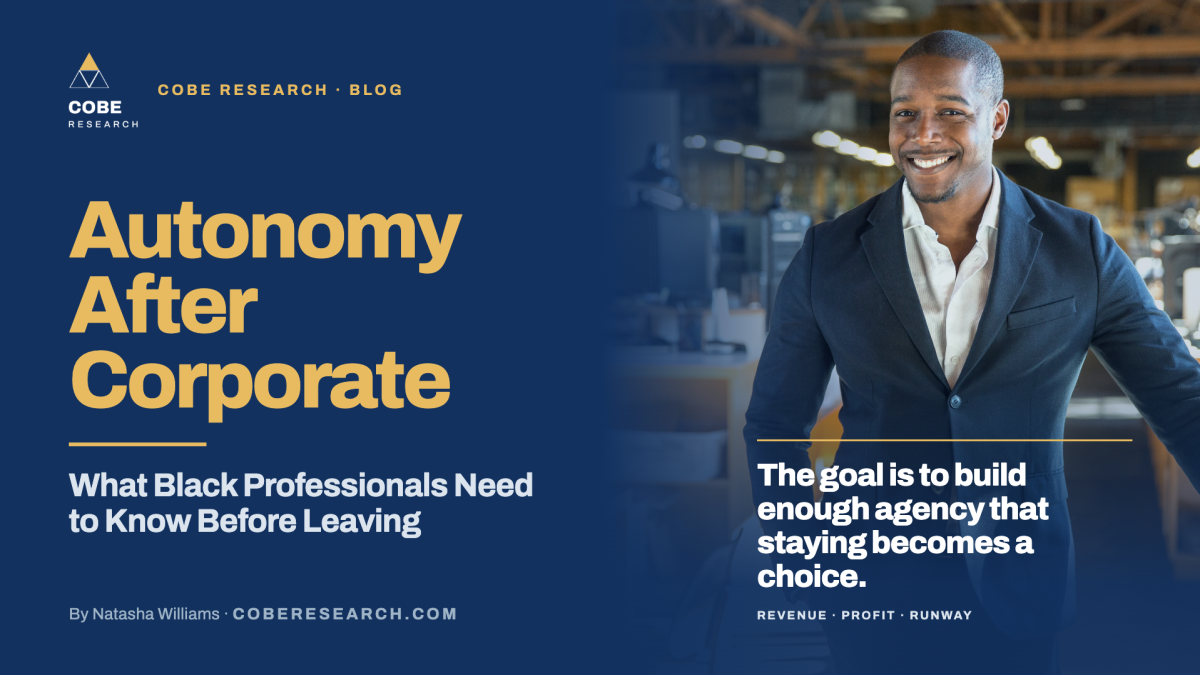
Explore how Black professionals can build greater autonomy, protect their wellbeing and create work with more control, choice and ownership.
In the Cost of Black Excellence research, 91% of contributors said they had considered leaving their organisation. Behind that figure are people thinking about consultancy, self-employment, portfolio careers, freelancing and building businesses of their own.
The desire for greater autonomy is understandable.
If work has started affecting your health, confidence, energy or sense of possibility, leaving can begin to feel like the only route back to yourself.
But leaving employment and building freedom are not the same thing.
Recognising what work is costing you is one part of the process. Recovering from prolonged workplace pressure is another. Building enough commercial knowledge to create a viable alternative is a different task altogether.
If you want more control over your working life, you need to understand how income is created outside a salary.
You need to understand customers, pricing, profit, cash flow, marketing, offers and financial runway.
That knowledge changes the conversation.
Revenue is not the same as income
One of the first things to understand about business is the difference between revenue and the money you eventually get to keep.
Revenue is the total amount your business brings in.
If you generate £8,000 in sales during a month, your revenue is £8,000.
That figure tells you something about demand, but it does not tell you how much money is available to pay yourself.
Software, contractors, advertising, professional services, insurance, equipment and other business costs all reduce what remains.
This is why someone building a route out of employment needs to understand more than sales.
You need to understand whether the business is producing enough surplus to support the life you want.
Profit tells you whether the business is working
Profit is what remains after your business expenses have been paid.
A business generating £10,000 each month with £8,500 in costs looks different from one generating £10,000 with £3,000 in costs.
Both businesses have the same revenue.
They do not offer the owner the same level of financial freedom.
Profit becomes especially important if your long-term goal is to replace your salary.
You need to understand how much the business needs to generate before tax, business costs and personal expenses are taken into account.
That gives you a more realistic picture of what financial independence through business would require.
You need to know what one customer is worth
Average customer value helps you understand the economics of your business.
If you generate £5,000 from 50 customers, each customer spends an average of £100.
If you generate £5,000 from five customers, the average rises to £1,000.
Those models require different approaches to marketing, selling and delivery.
If you want your business to generate £10,000 each month, you need to understand what that target means in practical terms.
The number matters because your business model shapes your workload.
It also shapes the amount of marketing, selling and delivery you need to sustain the income you want.
Marketing needs to produce more than visibility
Many professionals already have transferable skills, strong networks and considerable expertise.
That does not automatically create a business.
A business needs customers.
Customer acquisition cost tells you how much money and effort you are spending to gain each customer.
Paid advertising is only one part of the picture.
Networking takes time. Content takes time. Sales conversations take time. Events, email marketing, software and partnerships all require resources.
Understanding this helps you stop treating marketing as simply being visible.
The purpose of marketing is to create a reliable route between the people who need what you offer and the point where they decide to buy.
Repeat business creates stability
One of the hardest ways to run a business is to start every month needing a completely new group of customers.
Repeat business changes this.
Depending on what you offer, recurring income might come through retained consultancy, memberships, subscriptions, repeat projects, advisory work or customers moving from one service into another.
This is why your first offer does not need to represent the entire business.
It needs to solve a clear problem for a specific group of people.
From there, you start learning what they need next.
A business becomes more stable when customers return because they continue to see value in the relationship.
Your personal runway is part of the business plan
For anyone considering leaving employment, I would add one more number.
Your financial runway.
Your runway is the length of time your savings could cover your essential personal expenses if your income became inconsistent.
That does not tell you when to resign.
It tells you how much financial breathing room you have.
This matters because business income does not always arrive with the predictability of a monthly salary.
Financial pressure also changes business decisions.
When you have little runway, every potential client can start feeling essential. You can become more likely to underprice your work, accept unsuitable projects or build a business around immediate cash rather than long-term direction.
Building financial capacity gives you more choice.
That is one of the foundations of autonomy.
Business ownership is not the answer for everyone
I am not suggesting that every Black professional experiencing racialised workplace pressure should become an entrepreneur.
Some people want to stay in employment.
Some want senior leadership.
Some want to change sectors.
Some want to move into an organisation where their expertise is recognised differently.
Others want consultancy, freelance work, portfolio careers, fractional leadership or a business of their own.
The important part is having credible choices.
For years, much of the workplace conversation has focused on gaining access, improving representation and creating more inclusive organisations.
Those conversations remain important.
I also think we need to make more room for another question.
What if you no longer want the seat?
There are professionals who do not want to spend the next decade proving they deserve to remain at somebody else’s table.
They want greater control over how they work, who they work with, how they earn and how much of themselves they are required to sacrifice in the process.
Recognising workplace harm is important.
Healing from what you have experienced is important.
But if greater autonomy is part of what you want next, you also need commercial knowledge.
That is the conversation I want more Black professionals to have.
The goal is not to persuade everyone to leave corporate life.
The goal is to build enough agency that staying becomes a choice.
Continue the conversation
I am exploring these questions in more depth through COBE Research, my videos and the What Black Professionals Told Us About… series.
Continue on the pathway
Continue reading: What Black Professionals Told Us About…
Categories: : Career decision making, Build a business