Are We Repeating an Old Management Mistake With AI?
 Natasha Williams
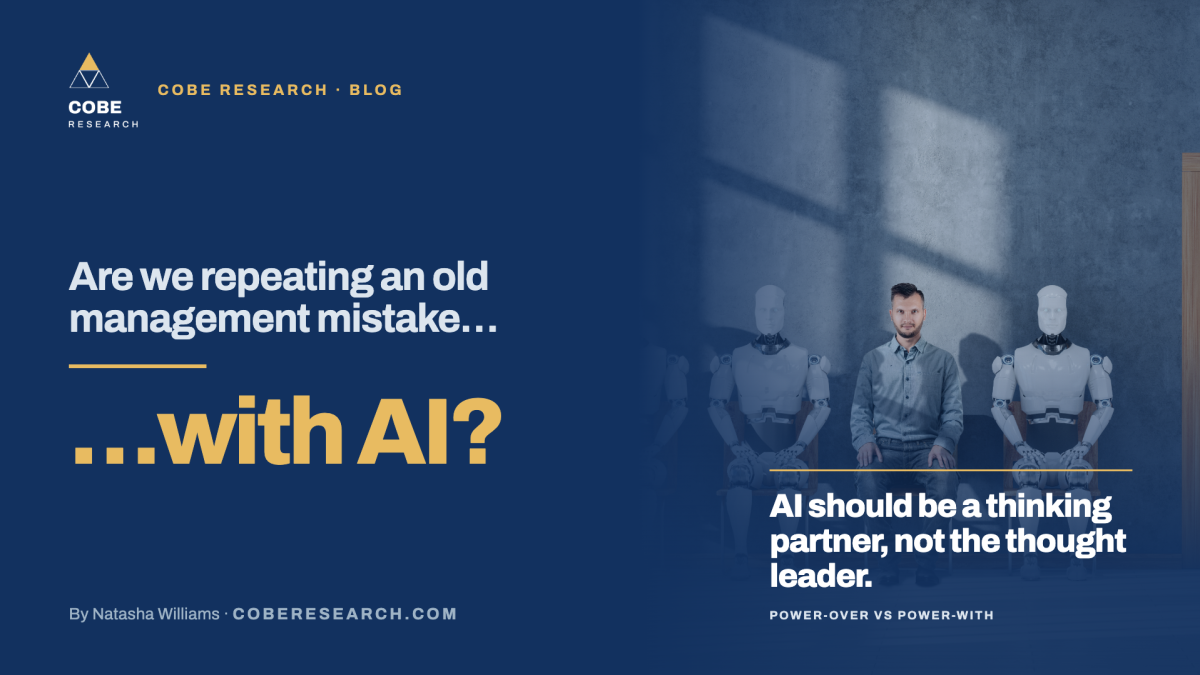
As organisations pursue AI-driven efficiency, this article asks whether we are repeating an old management mistake by designing people out of work.
I think we risk repeating a hundred-year-old management mistake: removing the human being from the equation in the name of efficiency.
Businesses understandably want to reduce costs, improve productivity and find better ways of working. I have run businesses myself, so I understand the pressure to meet targets, serve customers, manage costs and protect the bottom line.
My concern is the narrow definition of efficiency we are beginning to accept.
Increasingly, efficiency seems to mean completing more work with fewer people, automating human interactions and measuring success through speed, output and cost reduction. As organisations introduce artificial intelligence, I wonder whether this definition leaves enough room for the conditions humans need to think well, work well and remain connected to what they are doing.
More than a century ago, Mary Parker Follett was asking similar questions about management.
Follett challenged approaches built around coercion and what she described as “power-over”. She argued for “power-with”, where employees participated in solving problems and organisations recognised human needs alongside organisational objectives.
Her work came long before generative AI, algorithms and automated customer-service systems, yet the question underneath her thinking feels remarkably current.
Do we get the best from people by controlling and extracting more from them, or by creating conditions in which they can contribute well?
Efficiency is not the same as effectiveness
I am not anti-technology. My original career was in technology; I am an early adopter, and I use AI regularly in my own work.
AI saves an enormous amount of time on some tasks. Research involving thousands of knowledge workers has found that generative AI reduces time spent on certain activities and increases output in some forms of work.
Those gains are useful, but speed alone tells us very little about whether the work has improved.
We already see this tension in customer service. Businesses increasingly direct customers to automated systems before letting them speak to another human being. From an operational perspective, the reasoning seems straightforward: automation handles high volumes of enquiries at lower cost.
The customer experience looks different when an unusual problem does not fit the script.
Human beings bring context, judgement, empathy and the ability to recognise when something requires a different response.
An automated process that finishes quickly but fails to solve the person’s problem has achieved speed rather than effectiveness.
The same principle applies inside organisations.
I learned something different about performance while running my Building Surveying business
One of the strongest lessons I learned while running my surveying company was that people often give more when they feel the relationship between themselves and the organisation is reciprocal.
We had somebody within the business who was heavily focused on efficiency. His approach centred on getting people to do more, meet targets and increase output.
People did not want to work for him.
They did what they needed to do, but when he needed something beyond the basic transaction, they resisted.
My approach was different because I gave people reasonable autonomy while still expecting them to meet their responsibilities.
Family came first within the business because I genuinely believed that principle myself. I have five children, and if I worked for an organisation that told me I could not deal with an emergency involving one of them, I would immediately begin questioning whether I wanted to remain there.
I could hardly expect my staff to accept conditions that I would reject myself.
None of those decisions meant that standards disappeared.
People still had targets and responsibilities, and continuing poor performance would still have required a conversation.
What I found was that people generally met their targets, and I did not have a widespread problem with inefficiency.
Staff often went further when I needed them because they knew I would support them when they needed something from me. Surveyors and administrative staff told me they enjoyed working within the organisation.
Looking after human needs did not prevent us from running a commercially viable business. It formed part of how we achieved the performance we needed.
The Cost of Black Excellence research adds another dimension
My research with Black professionals has made me think even more carefully about the relationship between working conditions and performance.
One of the strongest patterns within the research is continual proving.
Respondents have described feeling that they need to work harder to be seen as competent, alongside experiences of overpreparation, self-monitoring, identity management, unequal scrutiny and pressure to demonstrate professional credibility.
One participant described the experience as:
“It is exhausting having to feel like you have to perform constantly.”
Another spoke about:
“The extra hours, energy, and emotional labour it takes to prove I belong.”
These experiences become important when we start discussing AI because employees are not entering the AI workplace from a neutral starting point.
Some people already feel they have to repeatedly demonstrate that they deserve their position. Others believe ordinary mistakes carry greater consequences for them, while some are already working beyond sustainable levels because high performance has become a form of professional protection.
AI introduces another layer to that experience.
For Black professionals already overinvesting in performance to establish credibility, that shift deserves attention.
AI risks creating a new form of continual proving
Imagine working in an organisation where senior leaders repeatedly describe AI in terms of headcount reduction, productivity gains and doing more with fewer people.
Employees understand what is being communicated.
An organisation might initially interpret that increase in activity as engagement when the underlying driver is fear.
Research is beginning to show how AI-related insecurity influences employee behaviour. Studies have linked AI-induced job insecurity with lower psychological safety, knowledge hiding, emotional exhaustion, intentions to leave and reduced thriving.
Evidence also suggests that confidence in learning and working with AI offers some protection, while greater autonomy appears to support better wellbeing.
This tells us that AI implementation should not be treated solely as the introduction of another tool.
It is also a job-design decision
AI should be a thinking partner, not the thought leader
This is the principle I increasingly use in my own work.
I use AI as a thinking partner.
Sometimes I wake up with an idea and want to explore it. I might use AI to test an argument, identify another perspective or point me towards research I need to read.
I still want the original thinking to be mine.
Sometimes I catch myself spending far too long asking AI what I might say about something when I already know what I think. At that point, I have to close the conversation and write.
Once I have developed the argument, AI becomes much more useful as a critic. It can identify gaps, challenge assumptions and point towards evidence I need to check, while the final judgement remains mine.
I think organisations need the same discipline.
Human judgement should sit above the technology, not underneath it, if AI is to strengthen work rather than define it.
Research involving knowledge workers has found that greater confidence in generative AI was associated with less reported critical-thinking effort, while greater confidence in one’s own ability was associated with more. Researchers also found that AI shifts critical thinking towards verification, integration and oversight.
That does not mean we should stop using AI.
It means people still need enough knowledge and judgement to recognise when an AI-generated answer is wrong.
If employees gradually hand more of their thinking to technology, organisations also need to ask whether they retain the underlying capability to perform the work independently.
A professional should still understand the profession.
The tool should strengthen the person rather than replace the person’s ability to think, because that is what keeps the work human.
Power-with offers another way of introducing AI
Follett’s idea of power-with offers organisations another model for AI implementation.
That creates a different relationship with AI because employees experience the technology as something they work with rather than something being done to them.
Psychological safety becomes particularly important within this relationship.
If someone does not feel safe enough to question an AI-generated answer, human oversight becomes little more than a phrase in a policy document.
For Black professionals, this connects directly with what we have heard through the Cost of Black Excellence research. Someone who already feels their competence is questioned more readily might find asking for help with AI professionally risky. A person who believes mistakes are judged differently might also feel less comfortable experimenting with unfamiliar technology.
When someone has spent years building credibility, the possibility of appearing technologically behind their colleagues adds another reason to overprepare.
The same technology will therefore produce different employee experiences depending on the culture into which it is introduced.
We should be careful not to create another performance race
The Black professionals who have contributed to our research have described what happens when work becomes a continual demonstration of worth.
They have reported fatigue, sleep disturbance, burnout, identity management, behavioural monitoring and the pressure to work harder to establish credibility. Many have also considered leaving their organisations.
AI is entering workplaces where these pressures already exist.
If organisations introduce the technology carelessly, some employees will try to become faster, work longer or make themselves indispensable. People who already believe they receive less grace might become even less willing to make mistakes.
Those behaviours can look like commitment from the outside.
My research has taught me to ask what sits underneath the performance.
High output does not always indicate a healthy employee. Sometimes it reflects somebody who is frightened of what will happen if they stop producing at that level.
We should not allow AI to turn that experience into the normal condition of work.
I would ask CEOs a different question
If I were speaking to a CEO whose primary objective for AI was to make the organisation leaner, I would not tell them to abandon the technology.
I would ask what kind of organisation they want to create with it.
I love technology, and I remain fascinated by what AI allows us to do. Some of my strongest ideas still begin by sitting down with another human being and having a conversation where somebody challenges me, another perspective appears, and I start thinking differently.
AI is useful afterwards because I can use it to test what emerged.
That is the relationship I want with technology.
AI should be a thinking partner, not the thought leader.
Follett asked organisations to think about power, participation and human needs more than a century ago. The tools have changed enormously since then, although the management question has changed far less.
As organisations pursue the efficiency AI offers, they should resist designing people out of work.
The organisations that use AI well will ask more than how much work they can extract from fewer people. They will consider how technology helps people think better, exercise judgement, retain autonomy, contribute ideas and perform meaningful work without continually having to prove that a human being still deserves a place in the organisation.
Continue the conversation
I am exploring these questions in more depth through COBE Research, my videos and the What Black Professionals Told Us About… series.
Continue on the pathway
Continue reading: What Black Professionals Told Us About…
Categories: : Career & Work, Workplace Wellbeing