Before You Leave Corporate, protect your health, money and career options first.
 Natasha Williams

There is a point in some careers when the question changes. you stop asking how to get promoted, how to become more visible, or how to prove yourself,
There comes a point in some careers when the question changes.
For years, the focus has been progression. You have thought about the next role, the next qualification, greater visibility, stronger performance and what needs to happen for your career to move forward.
Then the questions become different.
You start wondering how long you want to keep working this way. The next promotion loses some of its appeal. Another qualification no longer feels like the answer. Work takes longer to recover from, and the idea of doing something different begins to take up more space in your thinking.
For many of the Black professionals who contributed to the Cost of Black Excellence research, this shift did not reflect a loss of ambition. Their accounts described successful, educated and experienced professionals who had spent years doing everything they were told would lead to progress, while still feeling required to prove themselves repeatedly.
Some had reached a point where the effort involved in maintaining the career had started to compete with the life they wanted outside it.
This is where I believe we need a more sophisticated conversation about leaving corporate life.
The question should not begin with, “Should I resign?”
A stronger question is:
“What do I need to protect, strengthen, and understand before I decide what comes next?”
That is where The Protection Pathway™ becomes useful.
The pathway moves through five stages: Recognise, Protect, Position, Decide and Build.
By the time someone is seriously thinking about leaving corporate life, they have often begun the Recognise stage. They know something is no longer working.
The next step is not necessarily resignation.
The next step is protection.
Before you decide to leave, understand what you are trying to leave.
“I want to leave corporate” sounds like a clear decision, but it often contains several different problems.
One person wants to leave an organisation.
Another wants to leave a manager.
Someone else still enjoys their profession but no longer wants the version of success they have spent years pursuing.
A senior professional might still want leadership, but no longer wants leadership at the cost of their health.
Another person wants to remain employed while creating a business alongside their career.
Others have reached the point where the profession itself no longer fits the life they want.
Those are different decisions, and they require different responses.
Burnout has a way of making every problem look as though it has the same answer.
When work has taken too much from you, escape starts to feel like strategy.
Sometimes leaving is the right decision. My concern is with what happens when exhaustion makes the decision before you have had the opportunity to understand what you are leaving, what you are taking with you and what you want to move towards.
The Protection Pathway™ is designed to create that space.
Protect: Work should not take everything before you decide what comes next.
The first priority is protecting the resources that make choice possible.
I think about three things in particular: health, energy and money.
These are often the resources people spend while trying to preserve their careers.
The Cost of Black Excellence research showed how workplace pressure travelled far beyond working hours. Participants described sleep disturbance, persistent fatigue, burnout and emotional collapse.
Those experiences matter because career decisions are harder to make when the body and mind are already depleted.
An exhausted person doesn't need a career plan; they need enough capacity to think.
They need space to separate the question, “How do I get away from this?” from the more useful question, “What do I want my working life to become?”
Protecting your health sometimes means therapy. For someone else, it means working with a trauma-informed coach. In other circumstances, it means seeking medical support, taking recovery seriously, or recognising the physical consequences of prolonged workplace stress earlier.
None of those responses should be treated as an attempt to make someone more resilient to an environment that continues to deplete them.
The purpose is different.
Protection gives you enough of yourself back to make choices.
Protecting your energy means becoming more selective about where it goes.
Many high-performing Black professionals have built their careers around being dependable.
They become the person who handles difficult projects, takes responsibility when something goes wrong, helps colleagues, prepares extensively, and makes sure nothing is left open to criticism.
That behaviour often receives praise.
It also has a cost.
The Performance Tax™ helps explain part of this pattern. When credibility feels conditional, excellence stops being only about achievement and starts functioning as protection. A professional works harder because ordinary performance does not feel safe enough.
Over time, overpreparation becomes normal. Additional responsibilities feel expected. Saying no feels risky.
My research repeatedly brought me back to the same question: What happens when excellence becomes the price of credibility rather than the route to opportunity?
That is why energy belongs inside the protection stage.
Protecting your energy means deciding which work deserves your best thinking.
It means recognising when additional responsibility adds little to your career.
It means creating stronger boundaries around working hours.
It also means questioning whether every difficult workplace interaction deserves access to your emotional energy.
The aim is not disengagement.
The aim is conservation.
If you are trying to create a different future, your employer cannot continue consuming all of the energy required to build it.
Financial protection changes the quality of your career decisions.
Money changes the conversation.
It is easy to say someone should leave an unhealthy workplace when their mortgage, rent, children, debt, and financial responsibilities aren't part of the discussion.
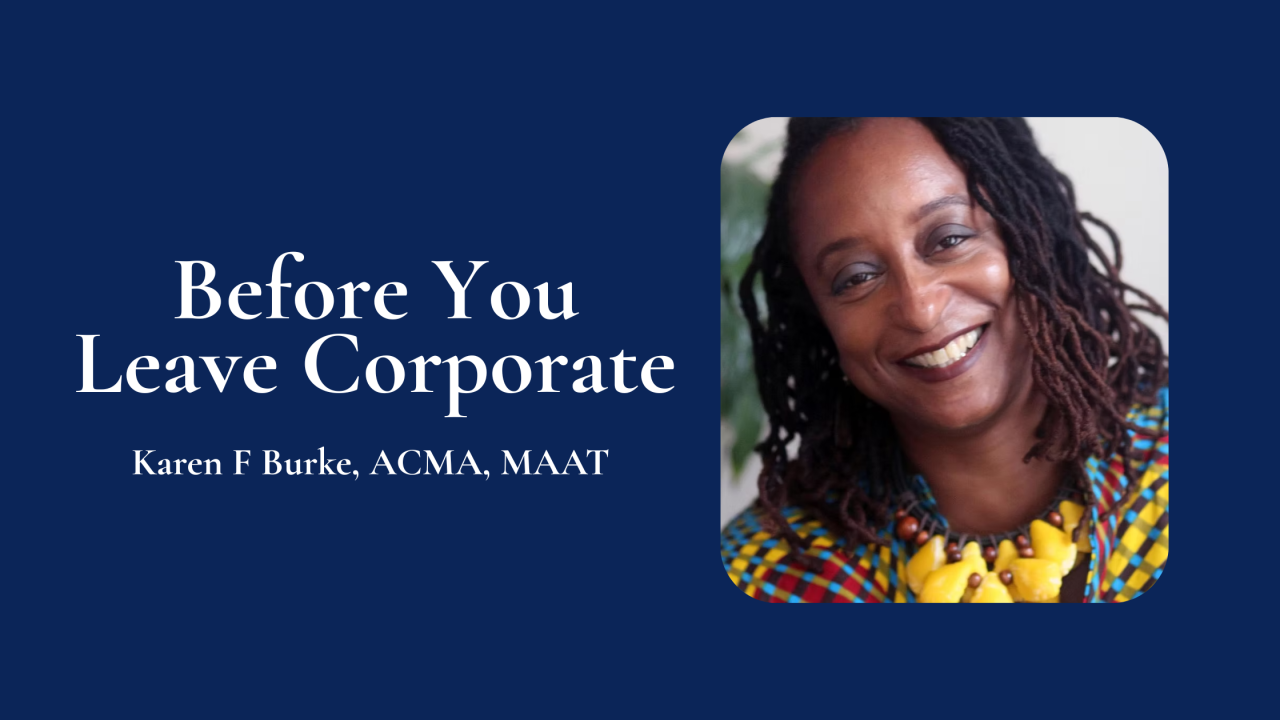
This became particularly clear when Karen Burke joined us for First Class Friday in Before You Leave Corporate: The Financial Conversation Nobody Has With You.
Karen brought the conversation back to something that often gets overlooked when people talk about career freedom: the numbers have to work.
We discussed the difference between a salary and the total employment package, the financial gap between PAYE employment and self-employment, the importance of understanding your monthly baseline, and the role of financial runway before making a major move.
That conversation matters because resignation is not the same as freedom.
Someone who leaves a difficult organisation with no financial margin often replaces workplace pressure with financial pressure.
A stronger position begins with knowing what your life costs.
How much income do you need each month?
What does your essential baseline look like?
How long would your savings support you without employment income?
Which benefits would disappear if you left employment?
How much would a business need to earn before replacing the security of your current package?
What financial commitments reduce your flexibility?
Those questions are not designed to frighten someone into staying.
They are designed to make leaving more deliberate.
This is one of the reasons I wanted Karen's session inside COBE Elevate. Career decisions should include the financial conversation before someone hands in their notice, rather than several months afterwards.
You can watch Karen Burke's Before You Leave Corporate session here:
Watch the First Class Friday replay
Position: Do not leave without understanding the value of what you have already built.
Once health, energy, and finances are better protected, the next stage is positioning.
This is where the conversation moves beyond survival.
The question becomes:
How do I strengthen my position before I choose my next move?
Many experienced Black professionals underestimate the amount of professional capital they have accumulated.
Years of work have produced more than a salary.
You have developed specialist knowledge.
You understand your industry.
You have solved problems.
You have built relationships.
You understand how organisations operate.
You know what good work looks like.
You have experience that younger professionals are still trying to acquire.
Burnout often obscures the value of these assets because the immediate desire is simply to stop.
Positioning asks you to look at them again.
The issue is no longer only, “Do I want this job?”
The more interesting question becomes, “What else is everything I know worth?”
Sometimes the problem is not the career. The problem is how the career is currently structured.
People tend to treat employment and entrepreneurship as opposites.
I think that limits the conversation.
A professional does not have to move directly from full-time employment into running a business.
Many positions fall between those two points.
A four-day working week creates one model.
Consultancy alongside employment creates another.
Board work introduces a different form of professional influence.
Teaching, speaking and advisory work create additional ways of using expertise.
A portfolio career combines several of these approaches.
For some professionals, the answer will still be a conventional leadership role, but in an organisation where the exchange between contribution and opportunity feels different.
Positioning is therefore about increasing the number of viable options before making a major decision.
The stronger your position becomes, the less your future depends on one employer saying yes.
The Progression Tax™ also deserves examination before you walk away.
One of the patterns within the Cost of Black Excellence research involved professionals whose strong performance had not translated into equivalent progression.
Some had extensive qualifications. Others had years of experience. Several were already carrying responsibilities associated with more senior work, yet the opportunity itself remained out of reach.
That creates an important question before leaving.
Have you reached the limit of your career, or have you reached the limit of what this particular environment is prepared to offer you?
Those are not the same thing.
Sometimes another organisation values the same expertise differently.
A sideways move opens a route that a promotion never did.
Sponsorship changes access to opportunity.
Moving into consultancy changes the relationship between expertise and income.
A board position changes how you exercise professional influence.
Another sector values experience that your existing organisation has started taking for granted.
Positioning requires you to examine all of those possibilities before concluding that everything you have built needs to be abandoned.
Sponsorship matters because performance alone does not always create movement.
Black professionals are often given more advice when what they need is greater access.
Mentoring has value, but sponsorship serves a different purpose.
A sponsor says your name when you are not in the room.
They introduce you to decision-makers.
They connect you with opportunities.
They attach their credibility to your potential.
This distinction matters because many high-performing professionals have already spent years improving themselves.
Another course is not always the missing ingredient.
Another qualification is not always the answer.
Another year of exceptional performance does not guarantee a different outcome.
Sometimes the career needs stronger positioning rather than more proving.
This is why the Position stage involves understanding who knows your work, who advocates for you, who has influence over your progression and where your expertise has value beyond your current role.
Building something alongside employment creates evidence before you make the final decision.
I am increasingly interested in the idea of Black professionals creating something alongside their careers.
That does not have to mean building a company with the intention of leaving employment.
The purpose is broader.
A small business, consultancy, teaching practice or paid advisory role gives you information.
It tells you whether people value your knowledge enough to pay for it.
You learn whether you enjoy working independently.
The experience shows you how much energy the work requires.
You begin understanding sales, delivery, pricing and demand.
Most importantly, you start seeing yourself outside the identity of employee.
That shift matters.
For someone who has spent twenty or thirty years inside organisations, leaving is not only a financial change. It is often an identity change.
Testing another professional identity while still employed creates a gentler transition.
It also gives you evidence.
By the time you reach the Decide stage, you know more about the alternatives.
Decide: The goal is to make the decision before exhaustion makes it for you.
The Protection Pathway™ leads into a decision, but it does not prescribe the answer.
Within my work, I often use four broad career responses: stay, challenge, reposition or leave.
Each deserves serious consideration.
Staying makes sense when the role continues to offer enough value, opportunity and support, particularly after stronger boundaries have been established.
Challenging becomes appropriate when workload, progression criteria, behaviour or another workplace issue needs to be addressed directly.
Repositioning changes the context without discarding the career. A different team, organisation, sector, working pattern or commercial model often creates an experience that looks entirely different.
Leaving becomes appropriate when the cost of remaining has exceeded what the role gives back and another direction better supports the life being built.
None of these choices represents greater courage than the others.
The point is not to celebrate leaving or romanticise staying.
The point is to make an informed choice.
The most important decision is not always whether to leave. It is what you want to move towards.
Leaving creates an exit.
A destination requires more thought.
If consultancy interests you, who needs the expertise you already have?
When entrepreneurship appeals, what problem do you want the business to solve?
For those considering a portfolio career, what combination of employment, advisory work, teaching, board positions or business would create both income and meaning?
If leadership remains important, what would need to be different about the next organisation?
When the priority is more time, what income structure would support the life you want?
Where wealth building matters, how will employment, business, investment or property fit into the strategy?
These are not simply career questions.
They are life-design questions.
At some point, success stops being about how far you have climbed inside an organisation and starts becoming about how much ownership you have over the life your career is funding.
Leaving corporate life should increase your sense of ownership.
I do not want Black professionals leaving one exhausting system only to recreate the same conditions somewhere else.
An eighty-hour working week inside your own business is still an eighty-hour working week.
A consultancy with no boundaries still takes a toll on your health.
Multiple income streams that leave no room for recovery do not automatically represent freedom.
The destination within the Protection Pathway™ is therefore not entrepreneurship.
The destination is ownership.
Greater ownership of your health means recognising when work is taking too much from you.
Greater ownership of your energy means deciding where your effort belongs.
Greater ownership of your money means creating enough financial strength to reduce dependency.
Greater ownership of your career means having more than one route available.
For some people, that leads to business ownership.
Others build portfolio careers.
Some move into board roles.
Many remain employed but develop a different relationship with work.
The structure will differ.
The principle remains the same.
Your career should support your life rather than consume it.
This is why I am building COBE Elevate around the Protection Pathway™.
The more I listen to Black professionals, the less interested I become in telling people to become more resilient.
Many are already remarkably resilient.
The more urgent question is what they should be required to endure in the first place.
COBE Elevate is therefore being developed around a different conversation.
The Recognise stage helps people understand experiences such as the Survival Tax™, Performance Tax™ and Progression Tax™.
The Protect stage brings in conversations about health, trauma, boundaries, recovery, financial security and protecting energy.
The Position stage focuses on sponsorship, progression, negotiation, career strategy, consultancy, business building and professional visibility.
The Decide stage creates space to think seriously about staying, challenging, repositioning or leaving.
The final Build stage looks at what comes next, whether that is leadership, entrepreneurship, portfolio work, board roles, wealth building or a different relationship with employment.
Karen Burke's session on leaving corporate life fits directly into this pathway because the financial conversation belongs before the resignation letter, not after it.
That is the sort of conversation I want COBE Elevate to hold.
We need fewer messages telling Black professionals to keep pushing through.
We need better information that helps people protect themselves, strengthen their position and make decisions with more options available.
Before you leave corporate, build enough choice to decide.
The final question is not whether you are brave enough to resign.
It is whether you have created enough protection, positioning and financial strength to decide what serves you next.
Sometimes the answer will be to stay.
Sometimes the right response involves challenging what is happening.
For another person, repositioning changes everything.
Leaving will also be the right decision for some.
The Protection Pathway™ does not tell you which answer to choose.
It gives you a framework for reaching the decision with greater clarity.
Protect your health, energy and finances before they are depleted. Strengthen your professional position so that no single employer determines your future. Then decide what you want your career to become, rather than waiting for exhaustion to decide for you.
From there, you are ready for the final stage of the pathway.
You are ready to build what comes next.
The Cost of Black Excellence™
What is success costing you?
Many Black professionals are succeeding at work while carrying pressures that remain largely unseen.
Download The Excellence Tax™: What Is Success Costing You? to explore the research into continual proving, identity management, workplace pressure, burnout and the personal cost of professional success.
Download the Report →Research and practical insight for Black professionals making informed decisions about work, wellbeing and career.